


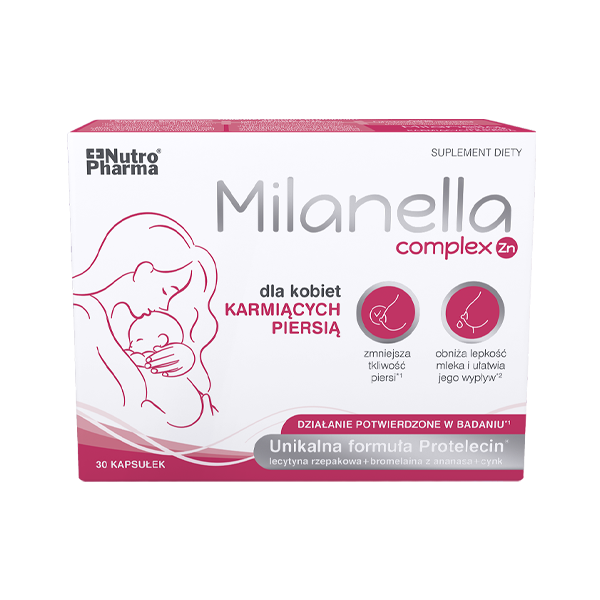
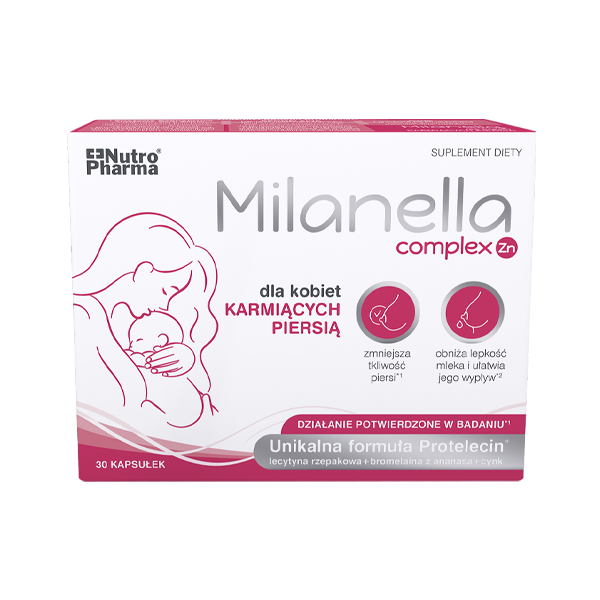

dietary supplement, 30 caps./1 pack.
Milanella complex Zn contains deoiled lecithin, bromelain from pineapple, and zinc. The product should be used as a dietary supplement as part of lactation advice.
- For BREASTFEEDING women
- Reduces breast tenderness1
- Reduces milk viscosity and facilitates its flow2
- ACTION CONFIRMED IN A TEST1
Rapeseed lecithin - A mixture whose main component is phospholipids, including phosphatidylcholine, which are natural components of human milk3. The product uses deoiled rapeseed lecithin powder, which contains a significant portion of valuable phospholipids in a small amount of the raw material (deoiled lecithin)4.
Bromelain - A natural mixture of enzymes derived from pineapple, which have the ability to digest proteins5. It exhibits a number of properties, including immunomodulatory properties and limiting the growth of certain microorganisms67.
Zinc - Contributes to maintaining proper fatty acid metabolism.
Scientific data:
- It has been proven that an adequate dietary supply of, among others, Zinc influences the synthesis of polyunsaturated fatty acids in erythrocyte phospholipids and in milk8. This is important, among other things, for the physical properties of milk – reducing its viscosity and facilitating its flow2.
- During lactation, milk flow may be impaired and may accumulate in the milk ducts. There is then a probability of growth of some bacteria10.
- It is indicated that the use of lecithin affects the amount of polyunsaturated fatty acids in milk, and therefore its viscosity and flow from the milk ducts2.
- Rapeseed lecithin is characterized by a high content of polyunsaturated fatty acids (approx. 88%) and a low content of saturated fatty acids (approx. 12%)11.
- Oral administration of lecithin is recommended in the management scheme in case of milk retention in the milk ducts (Clinical Protocol of the Academy of Breastfeeding Medicine (ABM)12, Recommendations of the Polish Society of Midwives13).
- In vitro studies show that bromelain has properties that limit the growth of some bacteria7.
- Increased growth of some bacteria may be associated with impaired milk flow from the mammary gland12.
- The results of a pilot study indicate that the combined consumption of lecithin and bromelain contained in the product, together with lactic acid bacteria – L. salivarius SGL03, reduces breast tenderness in breastfeeding women1.
Prepared on the basis of scientific data which do not constitute health claims. EU law prohibits the making of claims regarding the effects of bromelain and lecithin on human health. For this reason, we do not include such health claims on the labels of our products. However, we present the results of scientific studies based on Article 73 and 54 of the Constitution of the Republic of Poland.
- 1 Nehring-Gugulska M, Michalak E, Mińko A, Filipowicz N, Wietrak E. The use of natural ingredients (bromelain, lecithin, probiotic) as a supplement to the management of milk flow disorders in the mammary gland during lactation – a pilot study. Postępy Neonatol. 2023;29(1).
- 2 Lauwers, J., Swisher A. Counseling the nursing mother: A lactation consultant's guide. (5th ed.) Sudbury (MA): Jones & Bartlett. 2011. 255, 396–397 p.
- 3 Brink LR, Lönnerdal B. Milk fat globule membrane: the role of its various components in infant health and development. J Nutr Biochem [Internet]. 2020;85:108465.
- 4 American Lecithin Company. Lecithins and phospholipids: a simple guide to use and selection. 2009;1–19.
- 5 Chakraborty AJ, Mitra S, Tallei TE, Tareq AM, Nainu F, Cicia D, et al. Bromelain a potential bioactive compound: A comprehensive overview from a pharmacological perspective. Life. 2021;11(4):1–26.
- 6 Rathnavelu V, Alitheen NB, Sohila S, Kanagesan S, Ramesh R. Potential role of bromelain in clinical and therapeutic applications (Review). Biomed Reports. 2016;5(3):283–8.
- 7 Watters CM, Burton T, Kirui DK, Millenbaugh NJ. Enzymatic degradation of in vitro Staphylococcus aureus biofilms supplemented with human plasma. Infect Drug Resist. 2016;9:71–8.
- 8 Barrera C, Valenzuela R, Chamorro R, Bascuñán K, Sandoval J, Sabag N, et al. The Impact of Maternal Diet during Pregnancy and Lactation on the Fatty Acid Composition of Erythrocytes and Breast Milk of Chilean Women.
- 9 Bichi E, Toral PG, Hervás G, Frutos P, Gómez-Cortés P, Juárez M, et al. Inhibition of ∆9-desaturase activity with sterculic acid: Effect on the endogenous synthesis of cis-9 18:1 and cis-9, trans-11 18:2 in sheep. J Dairy Sci. 2012 Sep 1;95(9):5242–52.
- 10 Fernández L, Cárdenas N, Arroyo R, Manzano S, Jiménez E, Martín V, et al. Prevention of Infectious Mastitis by Oral Administration of Lactobacillus salivarius PS2 during Late Pregnancy. Clin Infect Dis. 2016;62(5):568–73.
- 11 Kucia M. Properties and use of plant phosphatidylcholine in medicine, pharmacy, and cosmetology. Kosmetologia Estet. 2018;7(1):29–35.
- 12 Mitchell KB, Johnson HM, Rodrı JM, Eglash A, Scherzinger C, Zakarija-grkovic I, et al. Academy of Breastfeeding Medicine Clinical Protocol #36: The Mastitis Spectrum, Revised 2022.
- 13 http://www.ptpol.pl/media/dopobrania/ZG_PTPol_rekomendacje_standard_porady_laktacyjnej_poloznej.pdf.
Directions for use
Take 2 capsules 3 times daily with meals or according to the schedule recommended by your doctor/lactation specialist. The product should be used for 5 consecutive days. Do not exceed the recommended daily dose. This dietary supplement cannot be used as a substitute for a varied diet. Can be used together with the Milanella biom dietary supplement, containing the lactic acid bacteria Lactobacillus salivarius SGL03.Contraindications
Hypersensitivity to any of the ingredients. The product is intended for adult women.Storage
Store in a dry place, at room temperature, away from light and heat sources, out of reach of small children.
Comment