


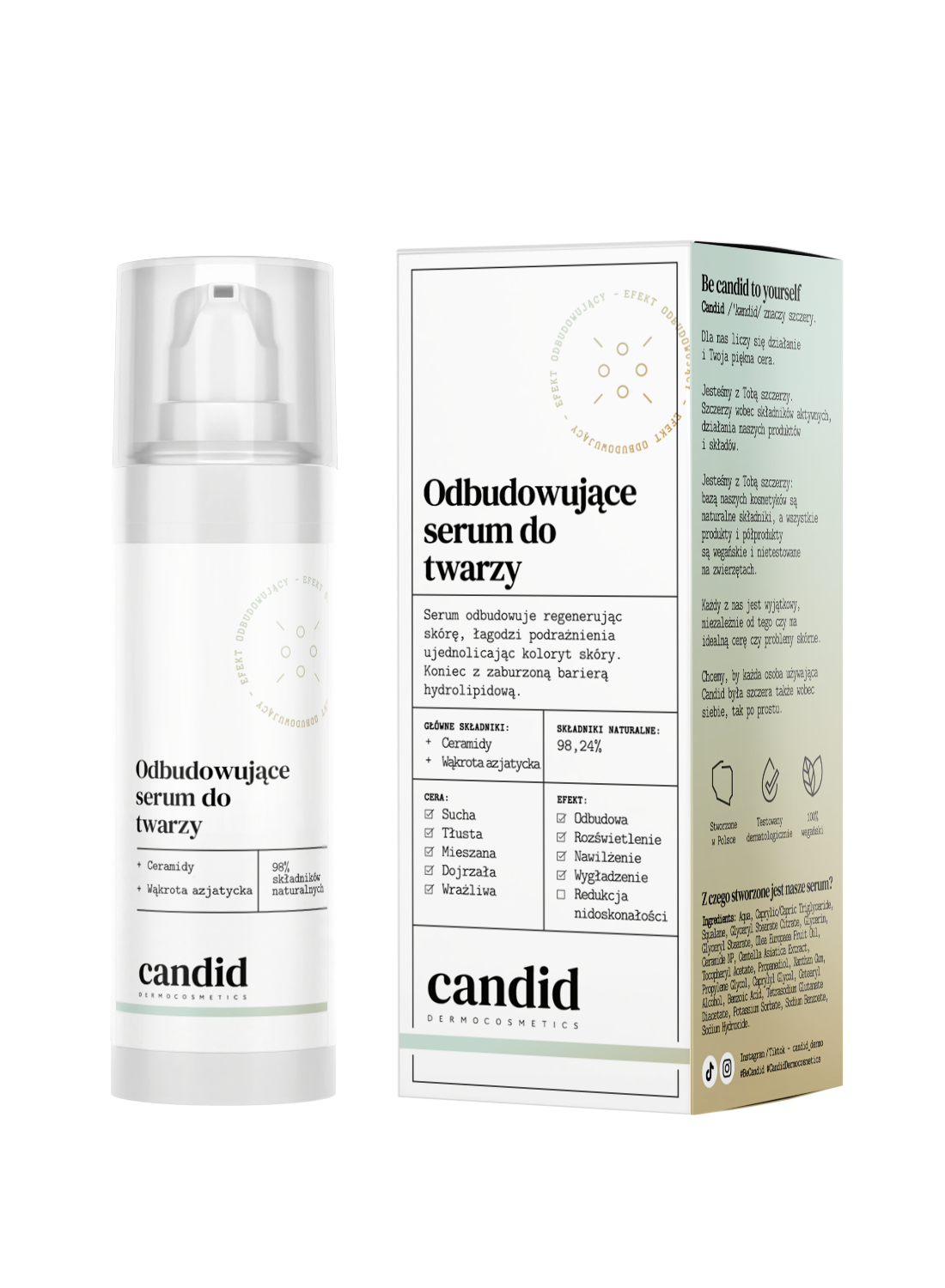

Regenerating Facial Serum with Ceramides and Centella Asiatica, 30 ml
98.24% ingredients of natural origin
100% vegan
Your Moisture Guardian. Still looking for a serum that truly moisturizes? Or maybe you've recently noticed that your skin is dry, tight, and after using cosmetics, it's simply unpleasant, acting as if something is wrong with it? And then there's that earthy color... It could be a disturbed hydrolipid barrier. When creating the Candid Regenerating Serum, we decided to add NP ceramides. These ceramides are commonly called moisture guardians; they are the most common in the lipid barrier, protecting the skin from moisture loss.
What exactly are ceramides? We're honest with you: they're simply the building blocks of our skin. What do ceramides in Candid serum do? They rebuild the skin's spatial structure. They fill out and thicken the skin from within. They firm and organize all layers of the skin. They reduce sagging facial skin and lift its contours. Centella asiatica, also known as tiger grass, is a powerful regenerative substance.
The centella added to Candid serum stimulates collagen and elastin production. It's no wonder this wonderful herb from China has become beloved worldwide – it's centella that helps maintain proper hydration levels. It also reduces dry skin. Isn't that exactly what you need right now? If your skin: needs intense hydration, is irritated, red, and inflamed, is often irritated after using cosmetics, is gray and dull, lacks radiance, shows signs of a compromised hydrolipid barrier. This restorative Candid facial serum will be perfect for you. The serum was tested on skin types similar to yours, prone to water loss. After just 4 weeks of regular use, respondents noticed: 80% of respondents declared that the product leaves a delicate protective layer that ensures proper hydration and lubrication of the skin, reduced water evaporation from the epidermis, lowered the TEWL parameter by an average of 16% in the group, thus strengthening the skin's hydrolipid barrier, improved skin smoothness by an average of 18% in the group.
Comment